
Vegetation Management Along Roads:
Legal Basics, Cutting Times, and Machine Selection at a Glance
Vegetation management along roads is a statutory duty. Municipalities, public works departments, and contractors maintaining roadside vegetation bear responsibility for the traffic safety of all road users.
On top of that comes the legal framework. The Federal Nature Conservation Act (BNatSchG) specifies when heavy cutback is allowed and when it isn't. And choosing the wrong machine not only costs money but also carries an increased risk of danger.
This article provides an overview of:
-
-
-
-
- legal requirements
- cutting times
- the clearance profile
- the question of which equipment is really suited to which roadside application
-
-
-
Why is vegetation management along roads necessary in the first place?
Without regular maintenance, branches extend into the traffic space, obscure road signs, and block drivers' view at intersections.
Vegetation management along roads therefore primarily serves traffic safety. It covers three core tasks:
1.
clearing the clearance profile
2.
eliminating sightline obstructions at intersections and signs
3.
protecting embankments from erosion
The latter is often underestimated. Intact vegetation keeps the soil on embankments stable.
If it is cut back too heavily or maintained incorrectly, the risk of erosion during heavy rainfall increases significantly.
Who is responsible?
Responsibility varies by road classification:
- Federal highways fall under the responsibility of the federal government
- State roads fall under the federal states
- Municipal roads fall under the local authorities.
Whoever is responsible is also liable if defects lead to accidents.
When may cutting be carried out along roads, and when not?
Heavy cutback and clearing of hedges, shrubs, and trees is only permitted during the dormant season under the Federal Nature Conservation Act: from October 1 to February 28. The reason is to protect nesting birds and their broods. Anyone who clears or heavily cuts back outside this window is committing a regulatory offense.
Shaping and maintenance cuts are permitted year-round. This also applies to measures that urgently restore traffic safety, for example after storm events, when branches threaten to fall or have already fallen onto the roadway. In these cases, the duty to ensure traffic safety applies and takes precedence.
What requirements apply to clearance profile cutting?
The clearance profile defines the area that must be permanently kept clear for traffic. Branches extending into this area pose a liability risk.
The minimum dimensions are clearly regulated:
- A clear height of at least 4.50 meters must be maintained above carriageways.
- Above footpaths and cycle paths, it is 2.50 meters.
- Lateral distances from the carriageway also apply and can vary depending on road classification and state law.
Whoever is responsible for vegetation management along roads must comply with these dimensions during clearance profile cutting and check them regularly. If an accident occurs because a branch extended into the traffic space, this can be deemed a breach of the duty to ensure traffic safety.
Vegetation Management Along Waterways:
What Applies Here?
Vegetation management along waterways follows similar basic principles to roadside management, but has its own responsibilities and requirements.
Bank vegetation protects embankments from erosion, filters nutrients out of surface water, and provides habitat for species typical of the waterway.
Responsibility for maintenance varies depending on the waterway classification:
- On federal waterways, the Federal Waterways and Shipping Administration
- On state waterways, the respective federal states
- On smaller waterways, often the municipalities or private owners
The cutting times under the Federal Nature Conservation Act (BNatSchG) also apply here. Heavy cutback is only permitted between October 1 and February 28. Along waterways in particular, overly aggressive intervention destabilizes the bank and can cause erosion and sediment input into the water.
How is vegetation management along roads carried out sustainably?
Vegetation management along roads is sustainable when it preserves the long-term vitality of the plants – and that starts with the quality of the cut.
A clean, smooth cut closes quickly and protects the plant from the penetration of fungi, bacteria, and moisture. In contrast, an imprecise cut leaves frayed wounds that serve as entry points for pathogens. The result: weakened plants, higher maintenance effort in subsequent years, and ultimately an increased need for replacement.
Choosing the right tool is therefore not just a technical decision – it directly affects the condition and regenerative capacity of the vegetation after cutting.
Which machines are suitable for vegetation management along roads?
The choice of machine depends on branch thickness, the location of use, and workplace safety requirements. Anyone carrying out vegetation management along roads essentially has three types of equipment to choose from.
Circular saw on boom arm
Suitable for: Thick branches, rough clearing work, tree cutting with very large diameters.
Not suitable for: Finer branches, dense hedges, and small-scale vegetation structures can only be handled to a limited extent with a circular saw. The large blade does not allow precise guidance through branches – hedges are cut unevenly, and delicate branches are too flexible and deflect the blade instead of being cut cleanly.
Workplace safety: The rotating blade flings wood chips and branch fragments uncontrollably in all directions. In populated areas and along busy roads, cutting therefore requires considerable safety precautions.
Cut quality and sustainability: Circular saws leave rough, frayed cut surfaces. Branches are often torn rather than cleanly severed. This weakens the plant in the long term and increases maintenance effort in subsequent years.
KM-X hydraulic pruning shear
Suitable for: Trees with branches up to 6 cm in diameter as well as broadleaf hedges – such as cherry laurel or beech. In roadside vegetation management, it is used wherever tree rows, roadside vegetation, and embankments with dense growth need to be managed.
Workplace safety: The KM-X operates without rotating blades. This means no flying splinters and no uncontrolled flinging of branch fragments. It can also be used in busy areas without the need for extra safety precautions.
Cut quality and sustainability: The KM-X's double guard fingers feature special serration on the side facing away from the tree. This holds the branch in place during cutting and prevents it from slipping away – allowing the blade to cut cleanly and under control. The double-sided, wedge-ground AxeCut blades sever branches smoothly and cleanly. The cut surface closes in a way that leaves moisture and pathogens no point of entry. This protects the plant and extends its service life.
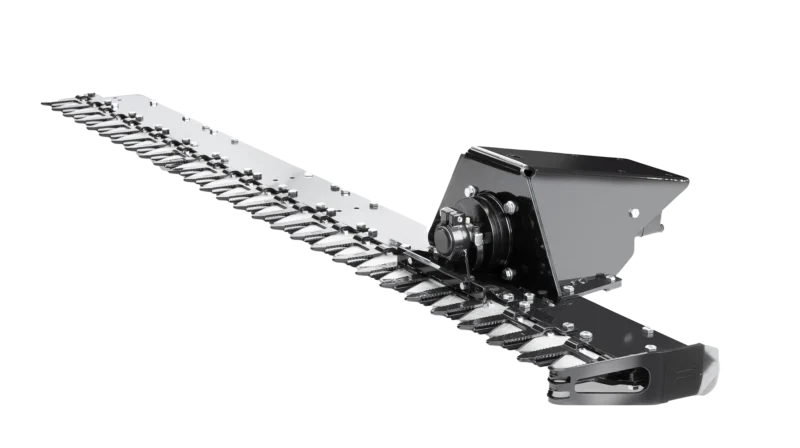 KM-X pruning shear | Group Schumacher
KM-S & KM-L hydraulic hedge trimmer
Suitable for: Light to medium hedge trimming, young vegetation, and overgrown edges up to 30 mm branch thickness. Ideal for roadside vegetation management along embankments, field and path edges, as well as ongoing municipal tasks.
Workplace safety: The enclosed blade system of the KM-S and KM-L does not fling cuttings uncontrollably. It can be used along busy roads and within towns without elaborate barrier measures.
Cut quality and sustainability: The ProCut blades deliver even, tear-free cuts with no rework needed and no open cracks in the wood. This promotes healthy regrowth and reduces maintenance effort in the long term.
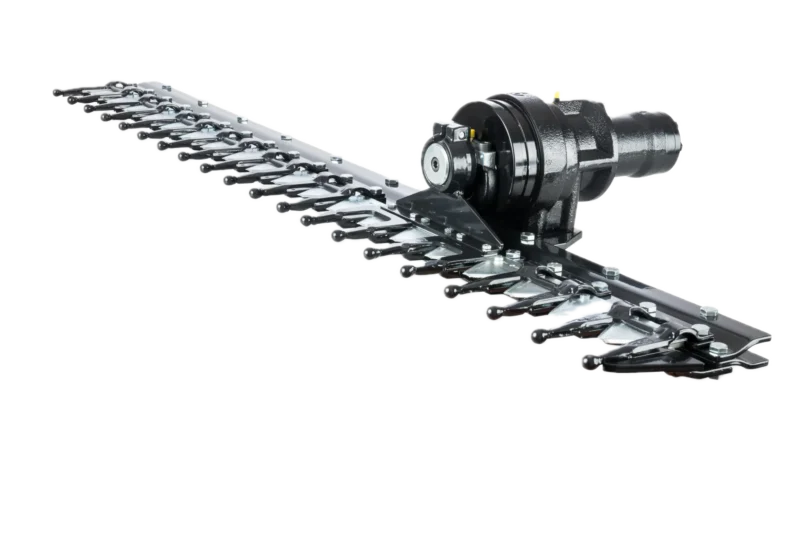 KM-S / KM-L hydraulic hedge trimmer – Group Schumacher
Which machines are suitable for vegetation management along roads?
A brief overview of which device is the right choice for which task in roadside vegetation management:
Looking for a solution for vegetation management along roads and waterways?
We're happy to discuss which device is right for your application in a short conversation.