
Detecting & Slowing Down Guard Wear | Tips & Solutions – GROUP SCHUMACHER
How to detect and effectively slow down cutterbar guard wear
Worn guards no longer cut; they tear. This consumes extra fuel, worsens the quality of the cut, and increases the risk of consequential damage to the drive. Those who detect wear early and use the right system can significantly extend service life and keep harvesting costs under control.
In this article, you will learn:
-
-
- How to reliably detect guard wear
- At what point a guard must be replaced
- What consequential costs worn guards can cause
- How the SCHUMACHER system extends their service life
- Whether a conversion is possible for your header
-


What happens when guards are too heavily worn?
If the wear on the guards is highly advanced, the crop is no longer cut cleanly but is literally "torn". The grain is pulled into the cutting gap instead of being cleanly severed at the cutting edge.
This has three direct consequences:
- Poorer quality of cut: Straw fibers stick to the guards, the gaps between the section teeth become larger, and the stubble pattern becomes uneven.
- Higher fuel consumption: Due to the worn cutting edges, the required cutting forces increase significantly, and the knife loses its guidance within the cutting gap. The system requires more energy for the same throughput.
- Increased risk of failure: Worn guards place greater stress on the knife drive and knife head. The probability of a component breakage increases. Downtime during harvest is the most expensive type of failure an operation can face.
How do you recognize wear on guards?
Wear on a guard manifests itself in several ways. Some signs are immediately visible, while others require a targeted check.
Visual inspection

Take a close look at the cutting edges of the guards. If these are noticeably rounded, the scissor-like cutting action no longer works properly. The stalks get jammed between the sections and guards instead of being cleanly cut.
A direct comparison with a new guard can help properly estimate the degree of wear on the cutting edges.
Check the quality of cut

Straw fibers sticking to the guards are a clear warning sign. The same applies to an uneven stubble pattern or stalks that look crushed rather than cut.
Measure the cutting gap

The cutting gap is the critical measurement. When installed, a new guard has a defined clearance between the cutting edges. If this gap widens too much due to wear, the guard has reached the end of its service life.
Check guards for damage

Bent or broken guards must be replaced immediately. This type of damage can lead to significant wear and poor cutting performance. The risk of consequential damage to the knife head and knife drive increases.
Use a testing tool

For checking the wear limit, SCHUMACHER offers the MultiTool: a keychain with an integrated testing wedge. The wedge is inserted into the cutting gap and directly and easily indicates the degree of wear on the guard.
How to effectively slow down guard wear
Wear cannot be stopped, but it can be significantly slowed down. A few targeted measures make all the difference

1.
Change sections in good time
Worn sections tear instead of cutting. This increases pressure on the counter-cutting edge and accelerates guard wear.
2.
Check the guide elements
If you only replace the guards but do not check the wear plates or roller guides, these will increase the wear on the new guards from the very start. Therefore, always check guards and guide elements together and replace them if necessary.
3.
Adjust the reel correctly
Incorrectly adjusted reel tines strike the knife, causing chipping on the sections. In their lowest setting, the tines should come no closer than 2 cm to the cutting system.
4.
Check for wear regularly
Once the wear limit is reached, degradation accelerates significantly. Checking too late risks not only higher parts costs but also consequential damage.
Why SCHUMACHER guards last longer
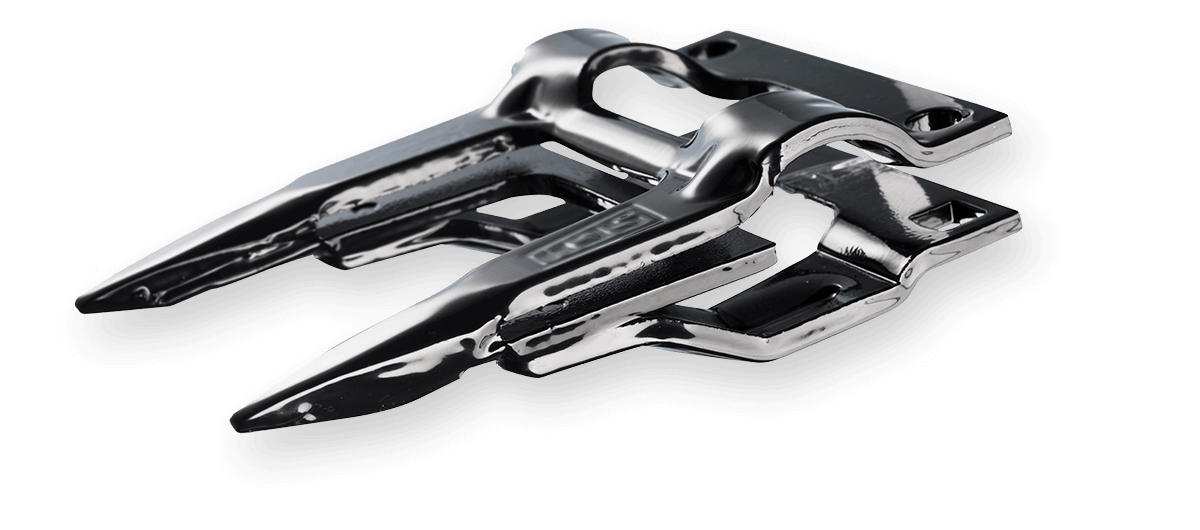
SCHUMACHER guards are manufactured as a steel welded assembly and refined using a special hardening process. They are bolted at both the top and bottom. This gives the system significantly more stability than one-sided forged fingers—a specific development designed to reduce guard wear and downtime.
Customers who have switched to the SCHUMACHER system consistently highlight the same points
-
-
- Higher stability of the guards
- Longer service lives for the overall system
- Cleaner quality of cut, even under difficult conditions
- Reduced maintenance effort during ongoing operations
-
Another advantage of the SCHUMACHER knife guide:
In the SCHUMACHER Comfort System, so-called roller guides handle the upper knife guidance. This reduces pressure on the wear plates and extends their service life.
The SCHUMACHER Premium System offers a completely roller-bearing-supported knife guide, significantly extending service life.
Converting to Schumacher: What is possible?
Many operations are not aware that a conversion is possible. Existing forged systems can be converted to the SCHUMACHER system. Conversion kits are available for the most common header models.

Mähfinger
Messersegmente und Messerverbindungen
Messerkopf
Führungsplatten
Schrauben und Muttern
Ersatzklingen
Ährenheber-Befestigung
Anbauanleitung
Optional: Rollenführung
A kit contains everything needed for the conversion:
- Guards
- Sections an knife connections
- Knife head
- Wear plates
- Bolts and nuts
- Replacement Sections
- Crop lifter attachments
- Installation instructions
- Optional: Roller guide
Upgrading to the SCHUMACHER cutting system increases harvesting performance and ensures safety and reliability during the crucial harvest season.
Want to find out if a conversion is possible for your header?
Get in touch with us directly.